Showing posts with label Women's Issues. Show all posts

Saturday, February 1, 2014

The Summer of Gods - Eliciana Nascimento


About the film:

The Summer of Gods is a short film about a troubled girl named Lili who unites with her Afro-Brazilian religious ancestry on a summer visit with family to their ancestral village in rural Brazil. Soon after her arrival, she encounters Orishas (African gods) who join with her grandmother to help her find peace with a gift
that has previously vexed her. The film is set in the Northeast of Brazil where Afro-Brazilian religious traditions remain strong. Lili's Grandma is a well revered local priestess who honors the Orishas. Lili is blessed by the goddesses as well. To preserve tradition, they lead her on a mystical adventure through a nearby forest which symbolizes her initiation into the tradition.


About the Filmmaker:

Film director Eliciana Nascimento now holds an MFA (Master of Fine Arts) in Cinema from San Francisco State University. This was her MFA thesis film and her second narrative film.

Eliciana: “My interest in telling this story is to help preserve my ancestors’ traditions. Personal life experience informs its characters and theme as many elements of the film are pulled from my own childhood memories. As a native Brazilian living in a foreign country, I have developed an interest in Pan-African themes. I have noticed that the issues Afro-Brazilians face in Brazil are similar to those faced by African descendants here in the United States and in nations throughout the Americas. As a storyteller and social activist, my motivations around filmmaking are rooted in telling stories of people from the African Diaspora who have often been marginalized by societies and the mainstream film industry. My goal is to use cinema as a tool to reveal the beauty, culture and mythology of these people.

 Above text and images taken from The Summer of Gods website.

Here is a blurb that I found on Indiewire:
As the filmmaker herself describes her film which is...
...set in the Northeast of Brazil where Afro-Brazilian religious traditions remain strong. In the film, Lilli's grandmother is in charge of an annual celebration for the Orisha Yemanjá. In real life, the event is known in Brazil as Festa de Yemanja and it is the largest Orisha celebration in the country. In this event, devotees of African religious traditions dress in all white to take their offerings to the sea to thank Yemanja for helping them in their social and political struggles. In The Summer of Gods, this celebration is at risk of expiring because Lili’s great-grandmother is about to pass away. Grandma is a well revered local priestess who unites her community to honor the Orishas. Lili is blessed by the goddesses as well. To preserve tradition, they lead her on a mystical adventure through a nearby forest which symbolizes her initiation into the tradition.

This film looks so interesting!  I know very little about the Orishas, but I am very, very drawn to Yemaya/Yemanja.  I definitely want to see this film when it is released - too bad I wasn't still in The Bay Area where I could see it tomorrow in Oakland!

Saturday, January 18, 2014

The Kolo - A Community of Healing


For some time, I have been interested in learning more about the Slavic part
of my lineage.  Every now and then, I run into something that
really touches me and this video is one of those things.

You can read more about The Kolo Collaboration here.

Wednesday, January 15, 2014

Return to the Temple - Zola Dubnikova

Artemisia Gentileschi - artist


Judith Slaying Holofernes 
One of the most famous and skilled painters of the Baroque era, Artemisia Gentileschi was centuries ahead of her time. Among the first women artists to achieve success in the 17th century, she brought to her work an electric sense of narrative drama and a unique perspective that both celebrated and humanized strong women characters. Rediscovered by feminist art historians in the past few decades, Gentileschi has inspired a spate of books, both scholarly and popular, and a number of films. But it is the sensational painting Judith Slaying Holofernes (c. 1620) that epitomizes her career. The Art Institute of Chicago, in collaboration with the Foundation for Italian Art and Culture (FIAC), is thrilled to present this stunning work, an exceptional loan from the Uffizi Gallery in Florence, for its first display in Chicago.
The daughter of painter Orazio Gentileschi, Artemisia trained in her father’s workshop and quickly earned acclaim, completing her first signed painting, a dramatic yet sensitive rendering of Susanna and the Elders, when she was just 17. Her style bears some resemblance to that of her father, who was a follower of Caravaggio, but Artemisia’s paintings stand out for their theatricality—the raw emotional intensity of a few figures daringly arranged. The younger Gentileschi’s work is also distinctive in its focus on powerful heroines, capturing both their vulnerability and strength, a feature many attribute to events in Gentileschi’s own life. At the age of 18, she was raped by one of her father’s colleagues, Agostino Tassi. He was convicted in a trial a year later after Artemisia was tortured to “confirm” her testimony, but Tassi was never punished. Within months of the conclusion of the trial, Artemisia was quickly married and moved to Florence with her new husband.
The brutal depiction in the monumental Judith Slaying Holofernes is often interpreted as a painted revenge for the rape. Unlike other artists who focused on the ideals of beauty and courage evoked by the Jewish heroine Judith, Gentileschi chose to paint the biblical story’s gruesome climax, producing a picture that is nothing short of terrifying. As the heroine decapitates Holofernes, the general of King Nebuchadnezzar, to save the Jewish people, her brow is furrowed in concentration, her forearms are tensed, and blood spurts wildly from her victim’s neck. The startling naturalism of the scene owes much to the influence of Caravaggio; Artemisia followed his technique of painting directly from life and employing sharp contrasts of light and dark. The power of the scene, however, is all her own, and the painting endures as a masterpiece of Baroque art.
Violence and Virtue and its accompanying catalogue explore Gentileschi’s painting in the context of her remarkable career and the complex responses of Renaissance and Baroque artists to the story of Judith. The exhibition draws on the rich holdings of the Art Institute as well as a private collection in Chicago, putting Artemisia Gentileschi’s extraordinary work together with paintings and works on paper by such artists as Lucas Cranach, Jan Sanders van Hemessen, Jacopo de’ Barbari, and Felice Ficherelli, thereby enhancing a rare presentation of this truly pioneering and compelling artist.
Organizer
Virtue and Violence: Artemisia Gentileschi’s “Judith Slaying Holofernes” is organized by the Art Institute of Chicago in collaboration with the Foundation for Italian Art and Culture.
Sponsors
The exhibition is underwritten by the Old Masters Society of the Art Institute of Chicago.

Contributions were generously provided by John and Judy Bross; Scott, Lynda, Jonathan, and Lindsey Canel; and April and Jim Schink.
Artemisia Gentileschi. Judith Slaying Holofernes, c. 1620. Galleria degli Uffizi, Florence, inv. 1567.
Text is from The Art Institute of Chicago which just finished exhibiting this work.

Note:  Artemisia was tortured using thumbscrews as a means of "confirming" her testimony of her rape by Agostino Tassi.

There is a historical fiction of her by Andrea Vreeland entitled The Passion of Artemisia, which sounds like it would be an interesting read - I do love historical fiction.  I discovered its existence when I read this article about Artemisia.  And apparently, there is a movie about her, too, along with a couple of plays.

So much I don't know - so much fun learning!

Wednesday, December 25, 2013

The Lost Female Figures of Christmas - Carolyn Emerick


The Lost Female Figures of Christmas

Part I


It may come as a surprise that there were a great many female figures associated with this time of year that have been obscured from much of our contemporary memory. Many of these figures are still popular in their home countries. But, America has a very different historical landscape when it comes to holiday practice, and it is the American brand of Christmas that has recently been exported to non-Western parts of the world.

Much has been said about Santa Claus being an amalgam of influences, and especially about his image being based on the Germanic god Odin. But, it is important to realize that there were many other holiday figures, both male and female, that did not find their way over to our modern American Christmas celebrations. German male figures such as Krampus and Knecht Ruprecht are coming up more and more in news and entertainment media. So I would like to take this opportunity to celebrate the female side of Old Yule.


Mōdraniht - Mothers Night

A great place to start is the Germanic holiday of Mōdraniht. This holiday was part of the Yule festivities. Many people already know that the Twelve Days of Christmas comes from the fact that Yule was not just a one day celebration, but rather a festival that lasted for several days before and after the Winter Solstice.

Mōdraniht is literally translated as Mothers Night, or Night of the Mothers. We don't know a lot about this celebration because it would have been suppressed after conversion to Christianity. We do know that it was a time to celebrate motherhood and probably other female ancestors. This celebration of the feminine may be related to the age old correlation between the fertility of women with fertility of crops, and with rebirth of new life. The Winter Solstice, after all, celebrated the rebirth of the Sun and lengthening of days.

Just as it is in other indigenous religions, ancestor veneration was a very important aspect of Germanic spirituality. Both male and female ancestors were honored. But, it seems that female ancestors played an important role as guardians of the family line.

Hervor, a renowned shieldmaiden attested to in the Poetic Edda.  She is shown here dying after a battle.
Hervor, a renowned shieldmaiden attested to in the Poetic Edda. She is shown here dying after a battle.


The Important Roles of Germanic Women

Perhaps this has something to do with the fact that women were often the ones home guarding the homestead while men were off at war, raiding, or trading. We do know that like the Celts, Germanic women were often trained to wield a sword. Although women on the battle field was not as common as men, it was not uncommon either. There are accounts of female bravery in battle, and it is known that certain battle tactics were designed specifically for the shield maidens. So, it might be that the women who tended the homestead were seen as strong protectresses by their children. Indeed, many Germanic female names have elements of strength and battle in them. For example, the name Mathilde translates as "mighty battle maiden."

Whatever the case may be, we know that female ancestors remained a prominent element in Germanic heathen religion. They were celebrated not only during Mōdraniht, but they also enjoyed another holiday during the Autumnal Equinox - Dísablót. While Mōdraniht is attested in Anglo-Saxon sources, Dísablót is attested in the Norse. However, both cultures share a linguistic and cultural heritage.

Also, votive inscriptions along the Rhine demonstrate that a cult of "the Mothers" (also called Matres and Matrones) existed in southern Germany, Gaul, and Northern Italy. Half of the inscriptions are Germanic, while the other half are Celtic. This again demonstrates that the Old Religion placed a high emphasis on celebrating maternity and the feminine.

Mōdraniht was celebrated on the date that we now call Christmas Eve. So this year, raise a glass and toast to your own mother, grandmother, aunts, great-aunts, and all the women who have helped raise you and yours. This is surely an old custom that can be appreciated by people of any religion today!

The Norse Goddess Idunna. She guards the apples that give eternal life to the gods.


Obstacles in Getting to Our Roots

There are many aspects of folklore, tradition, and folk custom that have very deep roots. We must remember that some traditions have been immersed in Christian practice for many years, but their true origins exist in the dark crevices of old heathen custom.

The origin of such practices can be difficult to identify for a variety of reasons. The pre-Christian cultures in Northern Europe passed on their wisdom, histories, poetry, and myths orally. So in most cases, they didn't leave written records.

Another major obstacle is the way that the Catholic Church absorbed paganism, at the same time re-branding and replacing specific customs and figures. Gods became saints, pagan holidays became Christian ones. This comes as no shock to most readers. Most Christians are well aware that Christ was not born in December, that Easter is named for the pagan fertility festival in honor of the goddess Eostre, and so forth. It is commonly known that the Catholic cult of saints arose to turn people away from local deities.


You can read the rest of this fascinating article here.
Part II is here.

Carolyn Emerick's FB page is here.  Her website is still under construction and can be found here.

Saturday, December 21, 2013

Winter Solstice - When Darkness Nurtures Light by Judith Shaw

I found this article over at Feminism and Religion and loved it.  Am reblogging it here.

If you have never been over to Feminism and Religion, take a stroll over there for some fascinating and thought provoking articles by many women.  You will not be disappointed.

*********************

Winter Solstice – When Darkness Nurtures Light by Judith Shaw

photo of Judith Shaw, painter of Goddesses, trees and other beautiful things of natureIn the Northern Hemisphere Winter Solstice, usually December 21,  heralds both the time of deepest darkness and the beginning of the return to light.  It is a liminal day offering a transformation from darkness to light.
In the mid-latitudes in the ten days after the winter solstice the hours of sunlight increase by only a few seconds up to a minute or so.  The world slows down allowing a time to relish the quiet of long nights and the inspiration of winter dreams.
Inanna's Descent, painting by Judith ShawOur ancestors through out the world honored an aspect of the Dark Goddess at this time.  Inanna, ancient Sumerian Goddess, played many roles for Her people.  She was maiden, queen, gift giver, lover, and wife.  She became a Dark Goddess when she heard the call of the Underworld, which was ruled by Her sister, Erishkigal.  She passed through the seven gates and entered Her sister’s realm, naked and bowed low.  She  died and was reborn.  But She was transformed by Her experience of the darkness, gaining maturity, depth and clarity of vision. She was required to choose an alternative to take Her place, assuring the cyclical nature of transformation.  This was not an easy choice but She chose Her husband, Dumuzi. Out of all Her relations he was the only one who had not mourned Her death but instead had rejoiced in the resultant increase in his power.
One of the most well known stories about the transformative nature of this time of darkness is the Greek myth of Demeter and Persephone. Demeter, Earth Goddess of Grain had a daughter, Persephone.  Persephone lived in the golden glow of her Mother’s love and protection.
But like all youth she was compelled by curiosity and divine force to begin a journey of completion.  Persephone was walking in a meadow one day and she saw the beautiful narcissus flower – the flower of death. As she reached down to pick the flower, the earth split open, releasing Hades, the Lord of the Underworld. Hades then took Persephone, willingly or otherwise, in a Spiral Dance into the shadows of the underworld.
Persephone, painting by Judith Shaw
During this time Demeter was wild with grief.  She searched and searched for Persephone.  When She learned the truth of her abduction She caused all vegetation to die and wither on the vine.  Finally, with Zeus’s urging, Hades relented and released Persephone.  But before She reached the Land of Living she ate six pomegranite seeds thus sealing her fate of eventual return.
Like Inanna, she returned changed. She was filled with wisdom and knowledge of existence outside of her Mother’s realm. She had learned the power of transformation; from death to rebirth, from dark to light, lost to found, chaos to clarity, fear to transcendence.  And she was the one who must return to the Underworld for six months every year, recognizing the transformative power of darkness and the cyclical nature of transformation.
The ancient Celts also recognized a goddess at this time. The Cailleach (KAL-y-ach), which literally translates as the “Veiled One” is an ancient Dark Goddess whose origins are unknown.  When the Celts arrived in Ireland and Scotland She was there. She is the embodiment of winter, clothing the land with the whiteness of snow, ending the time of growth with the time of death and darkness.  As “The Veiled One”, in the quiet, dark of winter, She rules the hidden worlds, reigning over our dreams and inner realities.
The Cailleach, Celtic Goddess, painting by Judith Shaw
In one of Her stories, The Cailleach, as an old hag, seeks love from the hero.  If he accepts Her, She then transforms into a beautiful young woman, symbolizing the transformation occurring in the depths of winter when the seeds lay dormant in the earth.  Yet alive within this dormancy is the promise of rebirth in the spring, when Brigid picks up the mantle of the Goddess.
The Cailleach is the guardian of the life force, finding and nourishing the seeds, commanding the power of life and death. She personifies death and the transformative power of darkness.  She leads us through death to rebirth.
The Winter Solstice is a perfect night to light a candle and meditate on the wisdom of these Goddesses. They invite us down the path toward our inner darkness, through the barren surface into the unconscious depths where healing and new life begins. They teach us that we must take charge of this journey of transformation fueled by our dreams, introspections and inspirations. They teach us that on the other side of every fear we find freedom; we must die to our old ways in order to be reborn.  This quiet, dark time allows us to arrive at deeper levels of understanding and perception. May your night be warm and filled with dreams of inspiration.
Judith Shaw, a graduate of the San Francisco Art Institute, has been interested in myth, culture and mystical studies all her life.  Not long after graduating from SFAI, while living in Greece, Judith began exploring the Goddess in her artwork.  She continues to be inspired by the Divine Feminine in all of Her manifestations. Originally from New Orleans, Judith now makes her home in New Mexico where she paints and teaches part-time.  She is currently hard at work on a deck of Celtic Goddess cards. Her work, which expresses her belief in the interconnectedness of all life, can be seen on her website at http://judithshawart.com

Thursday, December 5, 2013

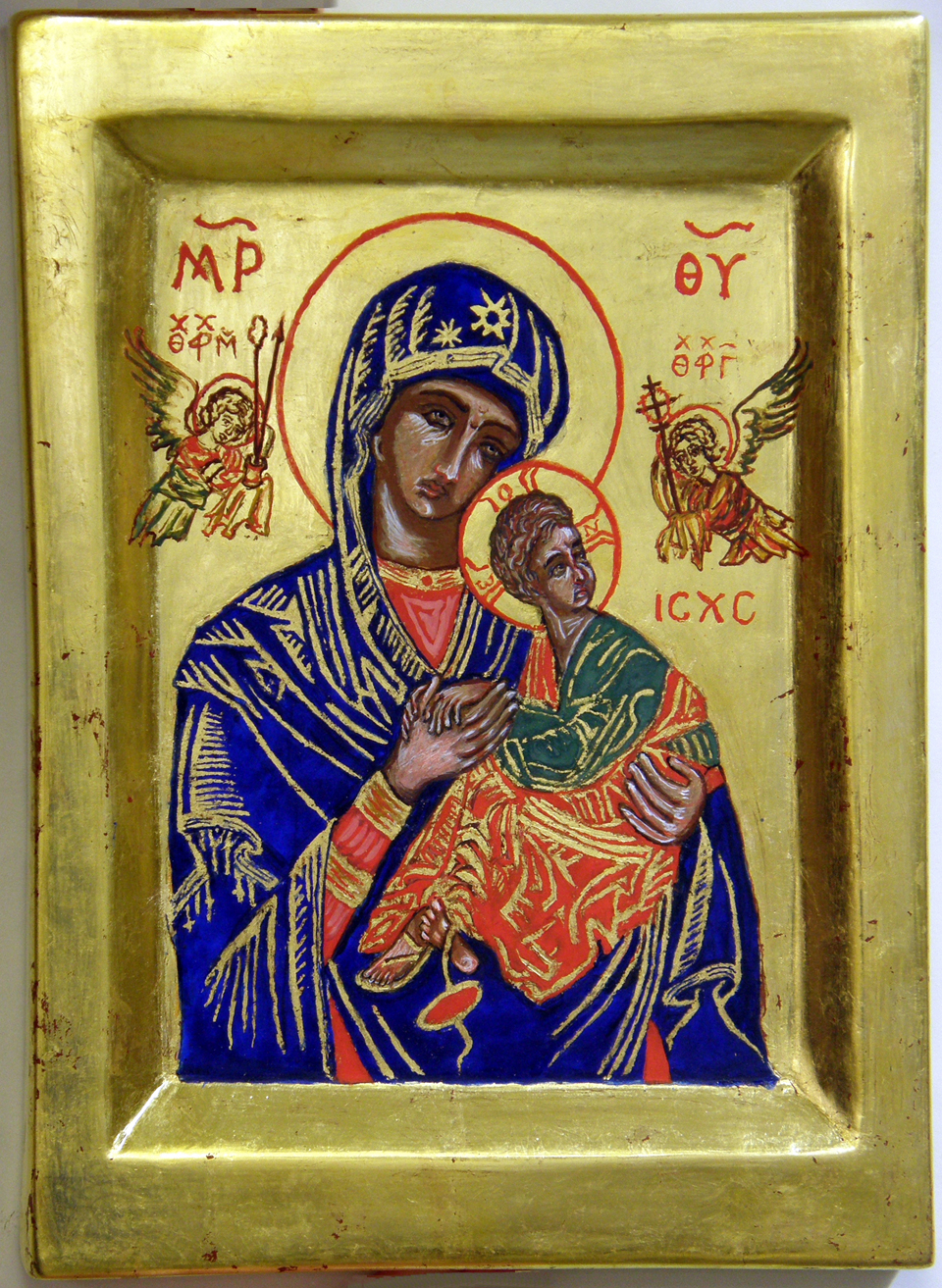
Virgin a Day, 2013 - Day 5 Our Lady of Perpetual Help

(Image from here)


I like to think of our Lady of Perpetual Help 

as helping all living beings

and not limiting Her love

to only humans...


Rebecca is hosting another yearly Virgin A Day over at her place - be sure to check out all of the offerings.

Tuesday, December 3, 2013

Virgin a Day, 2013 - Day 3 Isis and Theotokos


For I am the first and the last
I am the venerated and the despised
I am the prostitute and the saint
I am the wife and the virgin
I am the mother and the daughter
I am the arms of my mother
I am barren and my children are many
I am the married woman and the spinster
I am the woman who gives birth and she who never procreated
I am the consolation for the pain of birth
I am the wife and the husband
And it was my man who created me
I am the mother of my father
I am the sister of my husband
And he is my rejected son
Always respect me
For I am the shameful and the magnificent one.

This passage was first discovered in Nag Hammadi in the third or fourth century BC and claims to be a hymn to the Egyptian goddess Isis.

*********************
Aniscia Mosholder "prayers to the Theotokos, asking for protection"

On one side of Alexander Palace Papa stroked
his coiffed whiskers, pacing back and forth
in his simple study.

Ikons and photographs of family
Watched him all waiting in anticipation
for the news.

On the opposite side of the palace, Mama clenched
her dainty jaws, tears of joy and pain
streamed down her face.

Grigori led the Monks in chant, murmuring
prayers to the Theotokos, asking for protection
and health for the imp-child.

The imperial sheets matched the mauve room.
The resurrection child was born.

The news reached Papa thirty minutes later.
Disappointed in her grandiose arrival,
he delayed their first meeting.

The parade outside the palace
Dispersed, they too disappointed.


Rebecca is hosting another yearly Virgin A Day over at her place - be sure to check out all of the offerings.

Monday, December 2, 2013

Virgin a Day, 2013 - Day 2 Stella Maris


 (Image and text from here)
Fons Lucis Stella Maris
This Byzantine icon of Mary is venerated in the Roman basilica of Santa Maria in Via Lata 
under the title ‘Source of Light, Star of the Sea’.
It is one of several images in the Eternal City of Mary in the orante position, 
the prayer posture of early Christianity.

Stella Maris "sea-star" is a name of α Ursae Minoris or Polaris, the "guiding star" (also "lodestar", "ship star", "steering star", etc.) because it has been used for celestial navigation at sea since antiquity. The name is applied to the Virgin Mary in Saint Jerome's Latin translation of the Onomasticon by Eusebius of Caesarea,[1] although this is in fact a misnomer based on a transcription error. The Hebrew name Miryam, meaning drop of the sea, was translated by St Jerome into Stilla Maris, but at some later stage a copyist transcribed this into Stella Maris, and this transcription error became widespread.[2]   (Wiki entry)

The Afro-Cuban Orisha Yemayá and the Black Virgin of Regla, patroness of Havana, collection of the Musée des Arts Modestes - image and text from here.  
Every September 7th by the docks of Regla in Havana, thousands of Cubans await the procession of the black Virgin at the Church of Our Lady of Regla, patroness of the sea, of sailors and mariners, and of Cuba’s capital city. Devotees of the Virgin dress in shades of her colors: deep azure, bright turquoise, baby blue, and white. The majority board the lanchita, a small commuter ferry that runs between Havana and Regla, with white flowers and candles in hand, and some carry black “spirit” dolls elaborately dressed in blue and white. Women and men make their way through the crowd to one of the six small windows, where they cross themselves with coins, tossing the shiny offerings into the bay as they whisper appeals to the oricha of the ocean, Yemayá. Many dress in white and wear colorful beaded necklaces (collares) and multi-stranded bracelets (ides) that identify them as priests or priestesses of the Afro-Cuban religion, la Regla de Ocha, while others don gold crucifixes or saints’ medallions. Some wear both.  (You can read the rest of the article here.) 

 (Image from here)

Yemaya’s Wisdom

I am the force that swirls beneath the surface,
She who connects Sea and Sky,
the Infinite Mother who reclaims you.
Feel the sand beneath your feet, hold the conch to your ear,
gaze upon My Blue,
and you know Me.
Submit your troubles upon Me,
cast your cares into the heart of the ocean that is Me.
I will nurture you,
wipe your tears,
soothe the anger,
and shelter you from the coming storms.
In your surrender, I become your voice.
In the giving over, I become your freedom.
Daughter, come home, and allow Me
to make whole
that which is incomplete


This is the chant that I use when I cannot sleep or am mentally agitated.  I hope you enjoy it.


Rebecca is hosting another yearly Virgin A Day over at her place - be sure to check out all of the offerings.

Sunday, December 1, 2013

Virgin a Day, 2013 - Day 1 Anne and Mary


I saw this image a few days ago on Carol Christ's FB page with the explanation:
No it is not Mother Mary and baby Jesus, it is baby Mary with her Mother Anna, a reminder of Persephone and Demeter, and the ancient reverence for the generations of women.
First, I really like this type of iconography.  A lot.

Secondly, it got me thinking about Mary as a baby/child/girl/maiden - Virgin.

And about Demeter and Persephone.  About Mother and Daughter.  About their relationship.  About what knowledge is transmitted through Mother to Daughter, both in utero and after birth.

(Image from here)

It makes me want to know what kind of book Anne and Mary are reading in Murillo's painting.  Women in ancient patriarchal cultures weren't afforded the luxury of being educated - even in current times, many females are not deemed worthy of being educated - look at Malala shot last year by the Taliban for going to school.

I've read that Mary was dedicated to the temple at the young age of 3.  Perhaps the temple was not a Jewish temple since they did not accept females.  Perhaps it was a temple dedicated to the ancient Goddess, one which would have accepted girls.   Perhaps this book was one that contained their scriptures.

Perhaps it contained poetry, like this one written by Donna Wilshire:
Spring's daughter,
Full of Herself and Her blooming
Her Becoming
Her skin, flowering fresh petals
dew-pink, golden or brown
Her blushing parts vibrant
burgeoning with Possibility
Oh the Possibilities in Herself
the blossoming of Herself
the belonging to Herself

HEBE, VIRGIN!
Not belonging to mother,
not to father,
not to lover,
The Virgin belongs to Herself alone!

PARTHENIA
Youth exultant
Exulting in Her first bleeding
Exulting in Her connection to the earth
Exulting that She cycles with the moon
Exulting in Her magically transforming body

She--waxing, incipient
She--the sliver of New Moon
barely becoming
Hebe--the Virgin Moon!

This is the temple of Hebe, Virgin
In this temple, we celebrate spring
and all new beginnings,
starting over, renewing ourselves.
In this temple, we celebrate gifts that come unbidden,
being full of possibility,
pregnant with potential.
 
This temple of becoming! (F, p. 149 - 52)
I'm not one who subscribes to the usual definition of Virgin as a woman who has not had sexual intercourse.  I rather like this definition:

With her title "Holy Virgin," Mary joined the ranks of many other Goddesses with the same title: Athena, Asherah, AstarteAphroditeVenusAnat, IshtarDiana, and others. Clearly, since many of these Goddesses are also "Love Goddesses," the ancient meaning of the word "virgin" differs from our modern conception. 

"Virgin" indicated an independent autonomous woman, a woman not required to answer to any man or child. The title had little to do with abstinence from sexual intercourse (A, B, *). 

Perhaps Anne was relating the ancient stories from women and about women who were free and unencumbered by any philosophy or religion.  Perhaps she was teaching the connection between the female body, sexuality and the deep connection to Nature.  Perhaps she was explaining that freedom was the path of and to unconditional love.

Far more interesting for me to ponder than the Madonna/Whore dichotomy that's been pushed on to women.

Rebecca is hosting another yearly Virgin A Day over at her place - be sure to check out all of the offerings.

Thursday, July 18, 2013

Creation Story


Evrynome--A Story of Creation


Long, long in the past, far, far in the future,
At that point, before the beginning, after the end,
Where time and space do not exist,
Where all colors and forms are lost in the blackness of void,
There was a heavy vast silence,
A profound eternal motionlessness,
And nothingness and everything were the same.

And then Evrynome, Gaia, Goddess of a thousand names,
Mother of all,
Sighed.

And the sound of her breath echoed pleasingly in her ears.
As if it were a foreseeing
And yet as if it were remembrance,
She heard summer breezes ruffling tall green grasses,
And winter hurricanes howling through deep valleys,
And the pounding of the sea,
And the calling voices of all creation.
And so Evrynome, Gaia, Goddess of a thousand names,
Mother of all,
Pursed her lips and whistled for the wind.

Then slowly, smoothly, with perfect sensuality
She rose up from the timeless bed of her infinite rest
And caught up the wind
In her cupped hands,
In her streaming hair,
In the billows of her skirts,
And in the warm secret places of her body,
And she danced.

She danced delicately, she danced frenziedly,
She danced in staccato rhythm and liquid movement,
She danced with pure precision and orgiastic abandon,
She danced gloriously,
She danced holding the wind in her close embrace,
She danced the love and the joy of creation.
She danced and she danced.

And from the arch of her foot leapt the circles of time,
And from the curve of her spine, the spirals of life,
Day and night,
Black and white,
Absorption, reflection,
Birth, death, resurrection.
And as ecstasy grew, as the beat increased,
The wind blew wild and her belly swelled round.
And from the rivers of her sweat, oceans flowed,
And with each heave of her breast, mountains rose.
And when she threw back her hair and opened her hands,
Life teemed around her and harmony reigned.
Creation now danced in her perfect time
And she smiled.


~Christine Lavdas~
Poem found in this book

Wednesday, July 10, 2013

We dance our wildness....

“The wild is an integral part of who we are as children. Without pausing to consider what or where or how, we gather herbs and flowers, old apples and rose hips, shiny pebbles and dead spiders, poems, tears and raindrops, putting each treasured thing into the cauldron of our souls. We stir our bucket of mud as if it were, every one, a bucket of chocolate cake to be mixed for the baking. Little witches, hag children, we dance our wildness, not afraid of not knowing.”  
~Emma Restall Orr~  
 
Today, I feel Autumn in the air.  It usually happens for me in July, just as I feel Spring in the air in February.  Even with the heat and humidity, there is a slight coolness in the breeze that portends Autumn's arrival right around the bend. The shifting light is slightly, but noticeably different.  The air smells different - it's no longer the Spring/Summer fragrance of wild roses and honeysuckle, but something more earthy, musky, mysterious.

Autumn, for me, begins on Lammas, the first harvest and is my favorite season of the year.  The abundance of crops, the intensity of color, the laziness of Summer switching gears and rushing to ripen fruits and vegetables before the arrival of the inevitable first frost.  The dance between the fullness of Life and the closeness of Death - one tumbles into the other fearlessly, never doubting the endless cycles around our Sun.  It's simply a magnificent time!

(The image above was on my old blog and I'm not sure where I grabbed it on the internet. If this is your image, please let me know so that I can credit properly.)

Monday, July 1, 2013

Girl power - no, really!


As the internet and apps era has taken hold, younger people — often in their early twenties or late teens — have been achieving some incredible things, such as building hit mobile games or selling their startups to corporations for large sums of money. Lately, young teens participating in science fairs have also achieved some incredible things, such as this 15-year-old girl who created a flashlight powered by the body heat of one’s hand.
A 15-year-old high school junior from Victoria, British Columbia, Ann Makosinski, created a hollow flashlight powered by the holder’s body heat for the Google Science Fair. The invention made her one of 15 finalists, who will travel to Mountain View, California for a prize ceremony held this coming September. Google will choose one winner each out of three age groups, then from that will decide on the final winner, who will receive a grand prize of $50,000 and a trip to the Galapagos Islands.
Makosinski said she’s been quite interested in harvesting unused energy in the surrounding environment, which led her to discover Peltier tiles. Peltier devices, as people who get super into heat sinks know, produce electricity when one side of the tile is heated while the other side is cooled. This, in turn, led Makosinski to attempt to use Peltier tiles to provide enough power to an LED for it to generate enough light. She found it did provide enough power, but it didn’t provide enough voltage. Rather than give up, she reworked the circuit to allow for transformers, which would help increase the voltage. After buying — as well as building — circuits that didn’t get the job done, she eventually came across one that claimed to provide the necessary voltage. She bought it, and it worked.
The flashlight she built employ an aluminum tube slipped inside of a PVC pipe. The pipe was cut away in a certain area so the person’s hand would come into contact with the built-in Peltier tiles. The flashlight worked, but due to the temperature reliance of Peltier tiles, the flashlights worked better in colder temperatures (tested at 41 degrees Fahrenheit). The flashlight still worked in warmer temperatures (50 degrees, for instance), but the colder the surrounding temperature, the more the hand’s body heat can help the Peltier generate electricity. The flashlight maintained a sufficient level of light for over 20 minutes, definitely enough time to find the candles in the dark when the power goes out.
In total, Makosinski built the flashlight for $26, which is definitely a fine price for a flashlight that doesn’t require batteries, but she believes if mass produced, it could become even cheaper. If Makosinski wins the Science Fair in September, she’ll certainly be able to make a lot of flashlights.
Article found here.